
Baba Ganoush: The Smoky Aubergine Dip, and the Mama Ganoush We Make From It
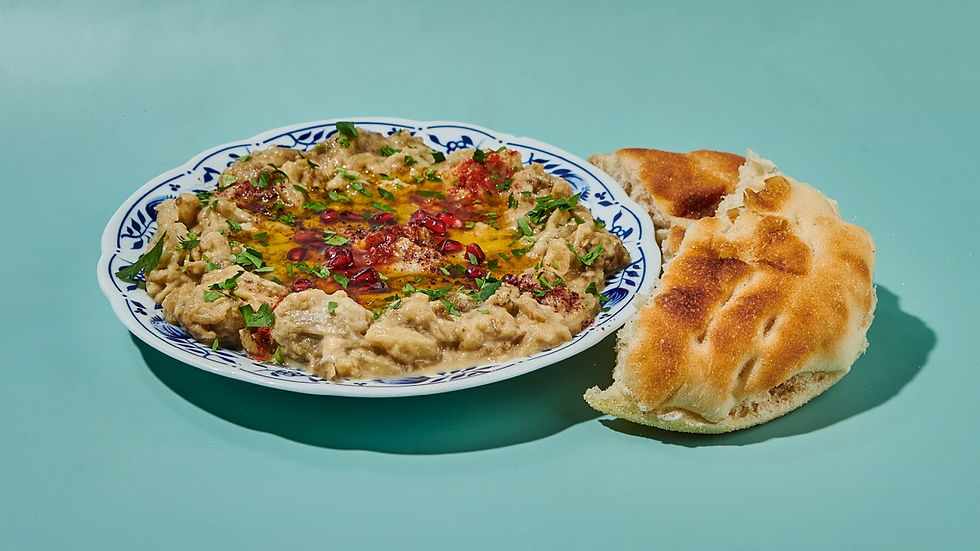
Baba ganoush is a dip made from aubergines that have been charred whole over a flame until the skin blackens and the flesh inside collapses into something soft and smoky. The flesh is scooped out, mashed and seasoned with garlic, lemon and olive oil, sometimes with tahini, and eaten with warm flatbread. It comes from the Levant and has close cousins across Turkey and the Eastern Mediterranean. At Kebap with Attitude in Berlin Mitte, our version is called Mama Ganoush. We roast the aubergines whole in our own kitchen, finish the purée with garlic, olive oil and parsley, and serve it vegan, with pide fresh from a bakery in Neukölln.
CONTENTS:
What Is Baba Ganoush?
What the Name Means
Where Baba Ganoush Comes From
Baba Ganoush or Mutabbal?
The Turkish Cousin
Fire or Oven: Where the Flavour Comes From
How It's Made, Step by Step
Baba Ganoush vs. Hummus
How to Eat It Properly
Our Mama Ganoush
Baba Ganoush in Berlin Mitte
FAQ
What Is Baba Ganoush?
Strip away the spelling arguments and the regional pride and baba ganoush is a very simple thing: a whole aubergine, burnt on purpose, turned into a dip. The skin goes black and papery over a flame or under a grill, the inside steams in its own juices, and what you scoop out is silky, pale and faintly sweet, with the smoke of the fire folded right through it. Mash that with garlic, a squeeze of lemon, good olive oil and salt, and you have the dish.
It's usually a light, earthy brown, looser than hummus and a little uneven in texture, with the odd soft strand of aubergine running through it. It's served cool or at room temperature, pooled with olive oil, and it belongs on a table with other small dishes, where bread does the work of a spoon.

What the Name Means
The name is Arabic, and it's more playful than it looks. Baba means father, or daddy. Ghannuj, the second half, comes from a word for coquettish or flirtatious, so the whole thing translates roughly as "pampered papa" or "spoilt father". One story has it invented in a harem kitchen to spoil the master of the house; another has a toothless old father whose daughter mashed his aubergines so he could still enjoy them. Nobody can prove either, and both are told with a smile.
The spelling shifts with every border. Baba ghanoush, baba ghanouj, baba ganuş in Turkish, baba ganoush on most German menus. They all mean the same bowl.
Where Baba Ganoush Comes From
Baba ganoush is a Levantine dish, from the stretch of coast and hills that today covers Lebanon, Syria, Palestine and Jordan. Aubergines have been grown there for well over a thousand years, having travelled west from India through Persia with Arab traders, and charring them over coals is about the oldest way of cooking them there is. The dip grew out of that habit, long before anyone wrote the recipe down.
From the Levant it spread in every direction. Egypt, Iraq and the Gulf each have their own version. The Armenians add cumin. The Greeks make melitzanosalata and eat it through Lent because it contains nothing from an animal. And across the border in Turkey, which matters most for a kitchen like ours, it became part of the standard mezze table under a different name.
Baba Ganoush or Mutabbal?
Ask in Beirut or Damascus and you'll hear that there are two dishes, not one. Mutabbal, which means "seasoned", is the smooth, creamy version: charred aubergine beaten with tahini, garlic and lemon, sometimes with a spoon of yoghurt. Baba ganoush, strictly speaking, is the chunkier, fresher one, chopped rather than puréed and tossed with tomato, pepper, parsley, pomegranate seeds and olive oil, closer to a salad than a dip.
Outside the Levant that distinction mostly disappears. In Europe and America, "baba ganoush" has come to mean the creamy tahini version, and that's the one most people picture. Neither use is wrong. It just helps to know that if a Lebanese grandmother corrects you, she has a point.
The Turkish Cousin
Turkey never needed the Arabic name, because it already had the dish. Patlıcan salatası, literally aubergine salad, is charred aubergine mashed with garlic, lemon and olive oil, and it's on practically every mezze table in the country. In some kitchens tahini goes in, in others yoghurt, in others neither. The aubergine itself is called köz patlıcan, which means ember aubergine, and the name tells you exactly how it's cooked.
That's the tradition our Mama Ganoush grows out of. The Arabic name gives people a handle they recognise, the method is the one Turkish cooks have used for centuries, and cooking the aubergine whole until it collapses is non negotiable.
Fire or Oven: Where the Flavour Comes From
The one thing every version agrees on is that the aubergine has to be cooked whole, in its skin, and cooked hard. The old way is over an open flame or a bed of charcoal, which is where the köz in köz patlıcan comes from, and it gives the flesh a real smokiness. Most restaurant kitchens, ours included, roast the aubergines whole in a very hot oven instead, until the skin wrinkles and darkens and the inside collapses. You lose a little of the campfire note and gain consistency, and the part that matters most still happens: the long, fierce heat drives off the water, concentrates the aubergine's natural sugars and leaves it tasting roasted, sweet and faintly bitter all at once.
That's why good baba ganoush is never bright white. A pale grey brown is what you want. If it's smooth, white and tastes mainly of tahini, the aubergine was steamed or boiled, and somebody skipped the heat.
How It's Made, Step by Step
There's no secret to it, only patience, and the sequence is the same whether it's made at home or in a restaurant kitchen.
The aubergines go in whole, skin on, over a flame or into a very hot oven. They're turned now and then until the skin has darkened and wrinkled all over and the aubergine has slumped in on itself, which takes longer than you expect. They rest until they're cool enough to handle, the skin is peeled away, and the flesh is left to drain, because an aubergine holds a surprising amount of bitter liquid. Then it's chopped or mashed by hand, never blitzed smooth in a machine if you want texture, and seasoned with crushed garlic, lemon juice, salt and olive oil, with tahini or yoghurt if that's the house style. It sits for an hour so the garlic softens into everything, and it's finished with a pool of oil and a scatter of parsley.
Our cooks do exactly this every day in our kitchen on Gipsstraße. We won't print the quantities, because that's the part that makes it ours.
Baba Ganoush vs. Hummus
People lump the two together, and they do sit side by side on almost every mezze table, but they're very different dips. Hummus is made from chickpeas, which makes it dense, nutty and filling, and its flavour is round and even from the first bite to the last. Baba ganoush is made from aubergine, so it's lighter, looser and far more complex: smoke first, then sweetness, then a little bitterness at the end, with the garlic and lemon cutting through all of it.
The best answer to "hummus or baba ganoush?" is both. One is comfort, the other is character, and warm pide between them is where the argument ends.
How to Eat It Properly
Baba ganoush is a dish for hands, not forks. Tear a piece of warm flatbread, use it to scoop from the edge of the bowl where the olive oil has pooled, and eat it in one go. Pide is ideal for this because it's thick enough to carry a proper scoop and soft enough to soak up the oil. A few other things it loves: a squeeze of extra lemon, a pinch of chilli, pomegranate seeds for crunch, and anything from the grill. Roasted against grilled works, which is why a spoonful next to döner meat is one of the quiet pleasures of a Turkish table.
Serve it cool, not fridge cold, and give it ten minutes out of the fridge before it goes on the table. Cold mutes the flavour.
Our Mama Ganoush
On our menu you won't find baba ganoush. You'll find Mama Ganoush, and yes, the name is a wink. If the original is the pampered father, ours is the mother who actually did the cooking.
It's our take on the roasted aubergine purée: whole aubergines roasted in our oven until the skin gives up, the flesh mashed and finished with garlic, olive oil and parsley, and served with pide for scooping. It's earthy and a little bitter in the best way, and we keep the texture loose rather than whipping it smooth. It's also completely vegan, with no yoghurt and no dairy anywhere near it. It sits in our cold mezze alongside Hummus and our Homemade Turşu, and it's one of the dishes people order again on the way out.
It works as a starter for two, it's one of the dishes you can put on the Mixed Mezze Tray, where you choose six mezze for the table, and it goes just as well beside a döner in pide as it does on its own. Like everything we make, it's part of what we call Natural Attitude: made in house, from honest ingredients, with no shortcuts.
Baba Ganoush in Berlin Mitte
You'll find us at Gipsstraße 2, a few steps from Rosenthaler Platz. We're a full service restaurant with space for up to 120 guests inside, on our front terrace and in our backyard garden. Come with people you like, start with Mama Ganoush and Hummus for the table, and work your way towards the kebaps slowly.
If you'd rather eat at home, you can order through Wolt, Lieferando or Uber Eats. And if you're feeding an office or a party, our online catering shop delivers mezze, döner and salads across Berlin.


Comments